Grenoble
Housekeeping knocked and woke me up. The night before I realized that the adapter I took from the hotel in Lausanne would not work here. There were three prongs, and I needed two. So my phone died, my computer died, and my camera remained dead. I didn't know what time it was, and I assumed it was later, in the afternoon, and I had slept in too long, because that's when housekeeping usually comes. I told the women I didn't need housekeeping. I didn't really tell her that, but the tone of my voice and my bad French did. I put on the grey zip-up hoodie that L gave me and the black Helmut Lang jeans M traded me and the foamposites that now can't be properly called white as they are so so dirty. I put on the dirty foamposites and I asked the lobby where I could get an adapter. He didn't know. He didn't know what I was asking and I facetimed with his daughter. And she didn't know what to tell me so I left to go find one.
I realized that it was not that late, it was still the morning, the city was coated in a layer of fog. It comes with the geography. When I was walking to the hotel in the sunset of the previous evening, certain sidestreets would open up into the most beautiful mountain views, enclosed by apartment buildings, some austere, some ornate. This morning I couldn't see the landscape, only the fog. I began to walk, keeping mental note of my turns so that I could make it back to the hotel. First I went to a Carrefour but they did not sell adapters. Then I found a cell phone shop and there they sold adapters. Only the man did not understand what I was asking for at first, and said that they did not sell adapters. But I saw what I needed hanging on the wall behind him and I asked him for it. He wrote down the price and I paid with my card. Then I asked him the time. He wrote that down as well.
I went back to the hotel and went back to bed. I slept until the afternoon. It has been so long since I've been alone and I had forgotten this tendency to collapse into myself, into nothingness, that without any relation to the outside world, I too cease to exist and cease to take actions towards being. I got up an hour before the sun would begin to set and took a shower. I washed out my braids and forgot how long my hair had gotten until the unraveling reminded me. This hotel is cheap, tiny, it was a shock at first as I was spoiled by the hotel in Lausanne. A shock to be reminded of the limits of what one can afford. But still, there is this affordance of silence. I remind myself of this. In the early morning I was texting J, complaining, specifically about the desk and the window. That the desk was too small, and that the window did not have good light. It was not what I had idealized, as far as the room that I would write in, in Grenoble. I would find that the desk was too small for my computer, but the perfect size to sit at with my paper, to write and draw with pens and markers and paints and brushes.
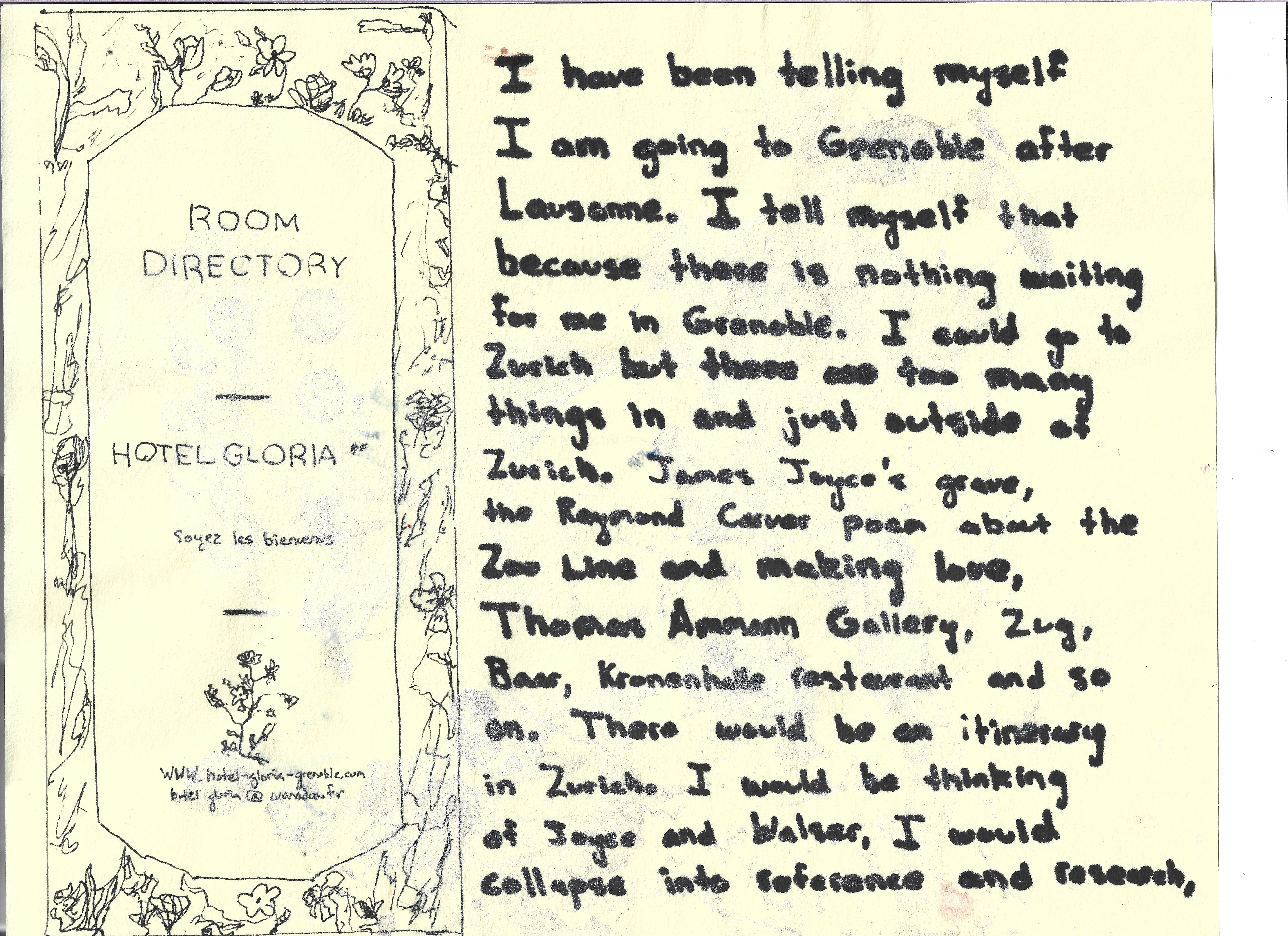
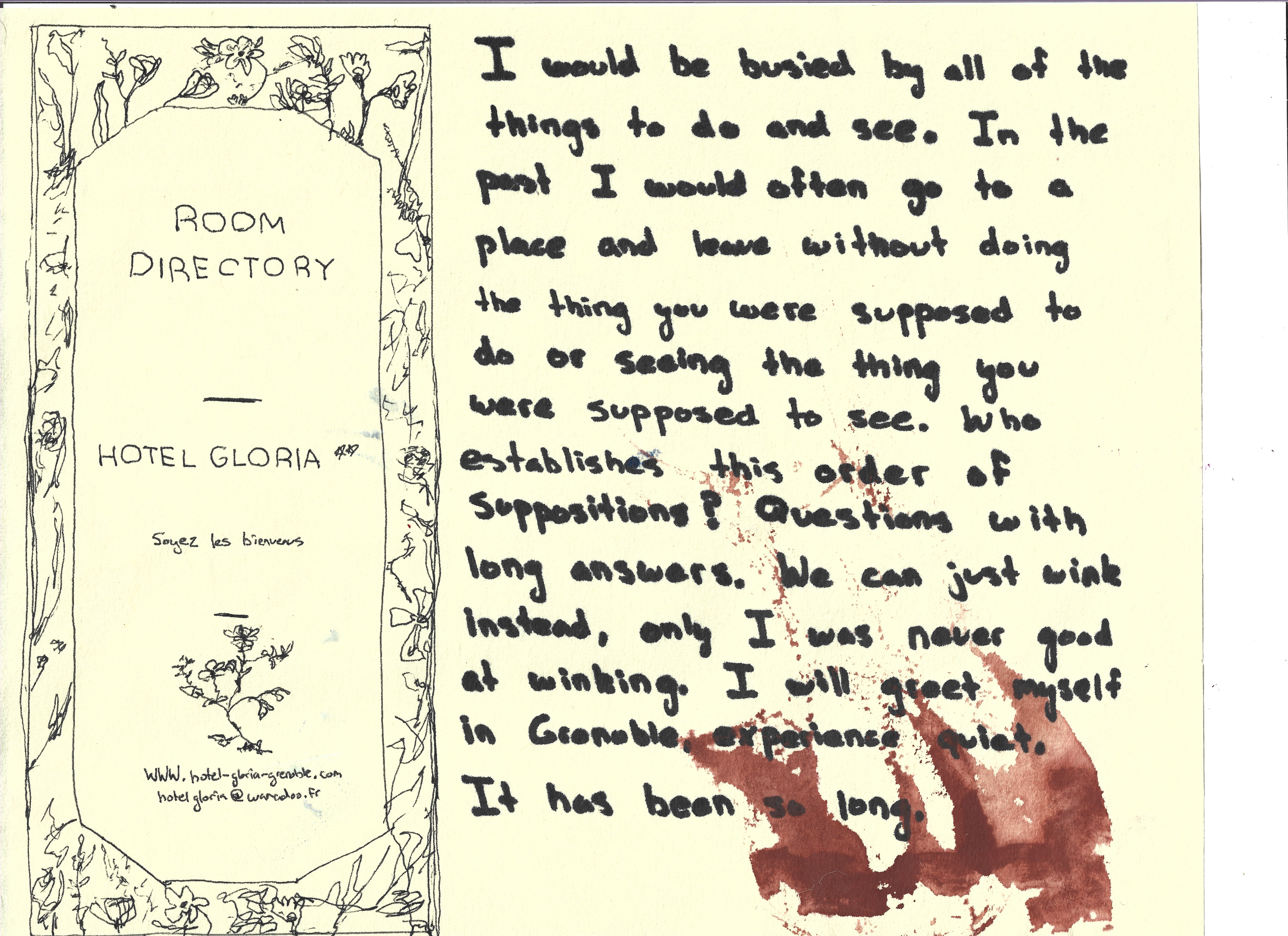
The hotel did not have stationary, only a tri-fold card with information about the hotel, its services, the wi-fi, transit in Grenoble, and the hotel breakfast. I traced the cover and rewrote what I had previously written about going to Grenoble, after reading and re-writing the A. L. Snijders story about Baalbek. Or rather Lydia Davis's translation of it. And I thought of this hotel I was in and I thought of the Palmyra Hotel in Baalbek. Naturally, I thought of Balbec as well, and of my conversation with S the previous night, where we touched on Proust and language-in-translation, and I had mentioned the Snijders book and its translation. We must have been talking about Amsterdam before. Or the Dutch. Until yesterday, I had not been to the Hotel Gloria in Grenoble or the Palmyra Hotel in Baalbek or the Hotel Cabourg in Balbec. At that point, all three existed in texts. The first two I had encountered through TripAdvisor, the reviews of the Hotel Gloria mentioned that it was old and there was art, much like the Palmyra Hotel in Baalbek. But it wasn't the type of old I imagined, my room's floor and walls were covered by this vinyl wood, recently applied, I am sure underneath there is some decaying wood, the floor creaks constantly, with every step I take in the limited space. This veneer was registered as another complaint to J.
But yesterday I arrived at the Hotel Gloria in Grenoble. Today I left it twice. The second time to eat. I went to a restaurant, Charlotte, that was still open, even though it was that period in between lunch and dinner when many of the restaurants here are closed. The women spoke good English. I ordered a croque monsieur and a red wine and finished the book of Alain Robbe-Grillet short stories while I ate. After I finished, she asked me if I wanted dessert and I ate a poundcake with chocolate chips. There was Genepi for sale, and other local products, and I asked how much the bottle was. She came back and told me that it was 45 euros but that I could also try a sample. I told her that I would decide later. I did not check a bag and checking a bag would be an additional 80 dollars or so. And I also have no extra room in my current bags to carry the Genepi or anything else. So the decision is not whether to spend 45 euros but to spend 45 euros and 80 dollars and the cost of another bag in order to bring back a bottle of Genepi and whatever else I decide fill that bag with. As for the sample, having wine with my first meal of the day felt like it was enough.
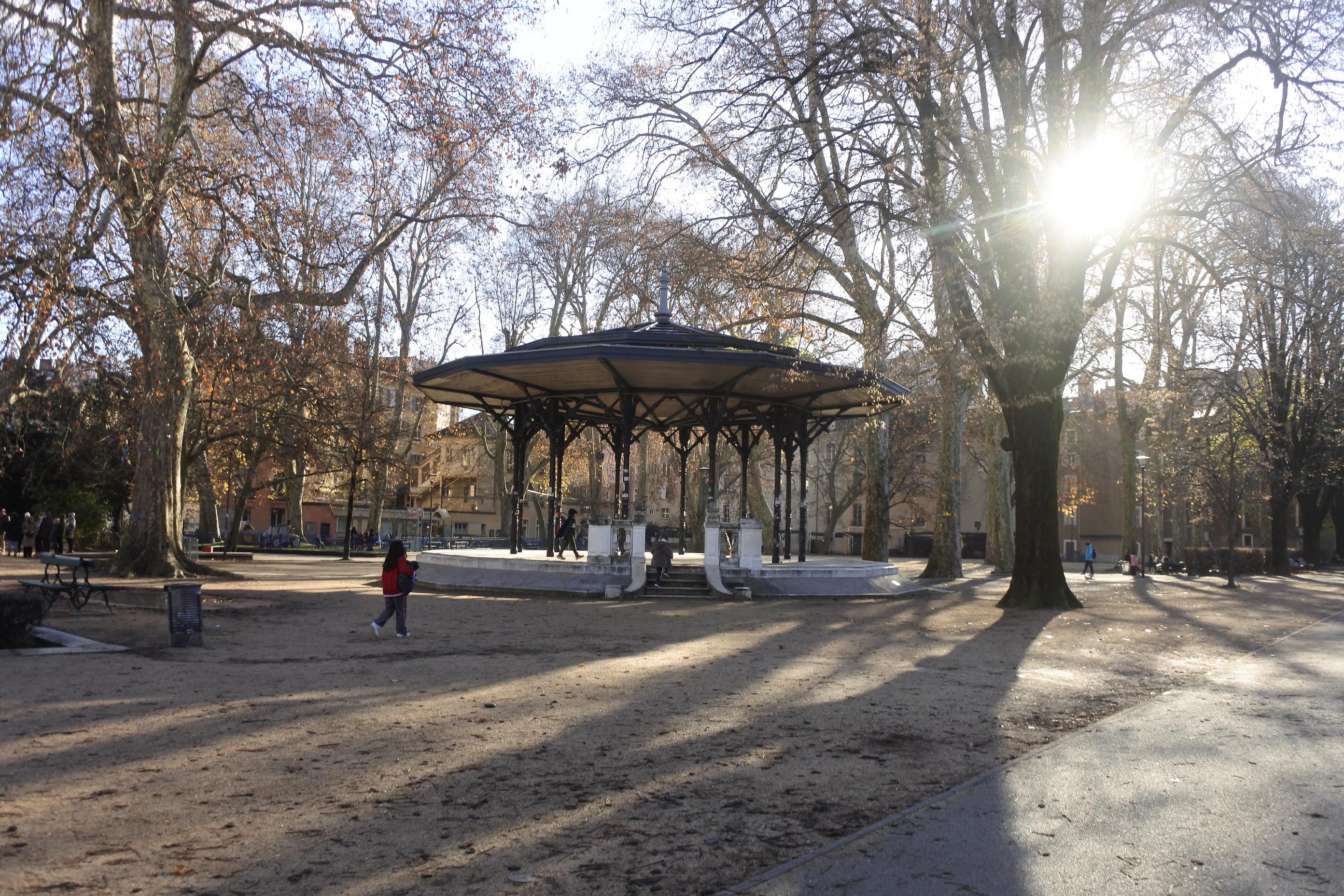
It was not foggy this morning. It may not be foggy again before I leave. While I wandered the streets looking for an adapter to charge my devices, I thought about how it was impossible for me to take a photograph of the fog. By the time I left the hotel again, the fog had lifted. This was when I went to Charlotte. After Charlotte, I walked around and then went to a restaurant close to the hotel, La Belle Idée, for dinner. Or a sort of dinner, for everyone else in the restaurant it was dinner. I brought the Javier Marías novel with me, A Heart So White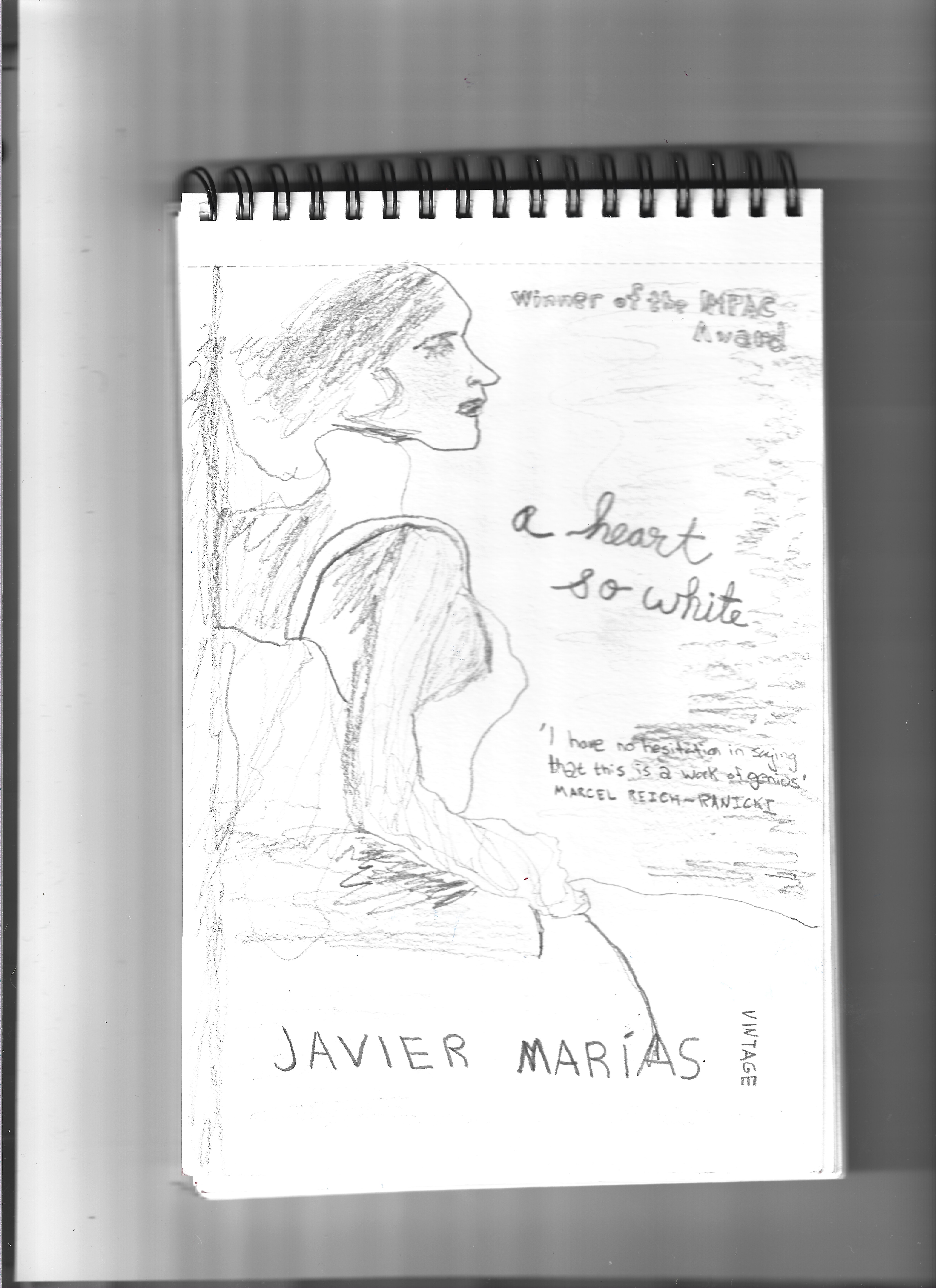 , which I bought because H had recommended Marías, not a book, but a name, by way of her brother, and when I was in the bookstore when I bought the Robbe-Grillet and the Snijders I saw it and I bought it, it had a somewhat seductive cover, a portrait of a Latin woman in a white dress, taken from a profile angle in black-and-white, sending attention to the shadow that contoured her shoulder and her dark lipstick. I got a red wine and a beef tartare, later a green chartreuse, local to the region. I did not like it as much as genepy, which I would drink later that night at a bar. Too sweet. At La Belle Idée I thought of La Belle Noiseuse and read Marías. The first scene was of a suicide, of a family finding the suicide, gruesome to read in a restaurant, but then the time and placed changed, the narrator was speaking of recording and memory:
And I was impatient because I was aware that what I didn't hear now I never would hear; there would be no instant replay as there can be when you listen to a tape or watch a video and can press the rewind button, rather, any whisper not apprehended or understood there and then would be lost for ever. That's the unfortunate thing about what happens to us and remains unrecorded, or worse still, unknown or unseen or unheard, for later, there's no way it can be recovered... what in fact happens are our notes or our recordings or our films and nothing more, even in that infinite perfecting of repetition we will have lost the time in which those events actually took place (even if it were only the time it took to note them down) and while we try to relive it or reproduce it or make it come back and prevent it becoming the past, another different time will be happening, and in that other time we will doubtless not be together, we will pick up no phones, we will not dare to do anything, unable to prevent any crime or death (on the other hand, we won't commit any or cause any) because, in our morbid attempt to prevent time from ending, to cause what is over to return, we will be letting that other time slip past us as if it were not ours... we cannot stop focusing our lives on hearing and seeing and witnessing and knowing, in the belief that these lives of ours depend on our spending a day together or answering a phone call or daring to do something or committing a crime or causing a death and knowing that that was how it was... Or perhaps there was never anything.
It wasn't until transcribing this passage that I realized I knew next to nothing about Marías. The book has no 'About the Author' and one of the blurbs compares him to Sebald. Naturally, I go to his wikipedia page and then onto youtube, and watch him talk about fiction in relation to truth for a few minutes. My copy, used, has someone else's annotations in it, annotations which are mind-numbingly dumb, with words like 'discuss', 'sexist', 'class', and 'yikes' scrawled into the margins. I cross them out as I pass through them, a stupid, pointless action, and what also crosses my mind is the types of readers there are, how readers are trained today, and within the realm of Spanish literature I criss-cross from Marías to Enrique Vila-Matas.
I remember a conversation with H about Vila-Matas, but it's more a recollection of having had a conversation than having the specifics committed to memory. We were talking about referentiality, how Vila-Matas would reference different writers, different works, scenes, characters, then stitch a text together via his relation to these things, which meant that the next necessitated an understanding of these references in order to gain pleasure from it. I would like to say that H used the word masturbatory, but I can't say that confidently. In any case, in the months that followed, I began to develop a framework for pleasure in relation to the production of texts, a spectrum ranging from masturbating to fucking, that I would never formalize in writing (or rather a serious piece of writing, unlike text messages sent to friends) but existed in conversations, evenings drinking with J and M and O, coffees with L, walks with I/O. It became important to think in this way, using this schema to construct works depending on context: a play, a lecture, a DJ set, a post. To think and make in relation to the public.
The importance of Vila-Matas, here, is not in regards to this framework, but to this story. To the hotel room. In Dublinesque he writes from the first-person, the narrator had stayed at a hotel in Lyon after lying to his parents about going to Lyon for a conference, a conference for publishers, as the narrator ran a press, and he went to the hotel in Lyon to attempt to write something, but went to the hotel in Lyon and could not write anything. I related to that experience, I had had a similar experience a few years before, before reading Dublinesque, where I stayed in a series of hotels in North India and did very little, wrote very little, with the intention of writing a significant work. Although my reason for not writing was not an inability to produce text, but a self-imposed lack of knowledge, as I had written out a flow-chart by hand dictating the possible flows of an essay, sprawling in topics which folded into and expanded out of one another, impossible to reconstruct back into a linear flow of text. And some of these topics I had only experienced as signifiers and not as the works themselves, thus it became necessary to read book after book after book in order to write this impossible essay, and my only writings, I would later realize, were my highlights and annotations. The task swallowed me.
But the Hotel Gloria was different. Because I came to the Hotel Gloria not with the intention of writing anything, but rather with the intention of experiencing quiet. The voice in my head would grow long during the dinners with myself, I would construct sentences and literary structures that the wine and the walk home would later wash away, and I would return to the dingy room and its itchy sheets, waiting to fall asleep. Still, I was frustrated, my hours were all wrong. I took a red-eye to Geneva and struggled to sleep. Instead, I started the collection of Alain Robbe-Grillet short stories and I read a journal article, titled "On Diaries" by Steven Rendall, a translator and academic. I can't remember why I opened that specific PDF, in fact I can only remember that it was an accident, but that once the accident had occurred, I thought it best to continue:
Both Boerner and Didier see the day-to-day format of the diary as underpinning its discontinuity and excluding any kind of general perspective or form. But Didier insists that the fragmentary character of the journal is not what defines it as a genre [14]. It would only confuse matters, for instance, to claim that because they are composed of fragments and incomplete, Pascal's Pensdes and Baudelaire's Mon coeur mis Anu are diaries; both are intended to be organized and completed and to defend a particular thesis. Neither such texts nor collections of maxims or aphorisms possess what Didier regards as the decisive mark of the diary and its specific difference: dated entries composing a chronological succession. This is for Didier the "touchstone" of the diary: it is not sufficient that the text be "fragmentary or relatively discontinuous. . . . In the journal, the discontinuity of the fragment is paradoxically linked to continuity-that of the progression from day to day" [32].
When Blanchot returns to the topic of journal-writing in Le Livre Avenir, it is in the context of the relation between writing and madness, and the journal appears as a "guardrail against the danger of writing" [227; the immediate reference is to Virginia Woolf's diary] - the danger of unveiling a world governed by chance and reversibility. By providing the writer with a foothold in the chronological order of everyday events, the journal allows him to glimpse – in his other works – the timeless abyss that literature opens up. The diary is thus located at the boundary between literary and "everyday" space, a "marginal" position in every sense of the word.
I only slept for a short amount of time on the plane. I remember drinking red wine, Swiss red wine, the bottle said Romandie, also the name of the venue I was DJing. I remember drinking the red wine and trying to fall asleep. There was a woman next to me, sleeping, she must have taken a pill to sleep. That was my assumption, she boarded the flight prepared to sleep. When I boarded the flight, she was already there, she had boarded with an earlier group, she had the aisle seat, but she was sitting in the middle, and offered me the aisle seat. She had no intention of getting up during the flight. During the meal services, the attendants would ask if we were flying together, so that I could make her food and beverage decisions for her, and I would say no, and she would continue sleeping. I felt flattered, as I thought she was quite pretty, and older than me by at least ten years. But I also couldn't look at her, for risk of her waking up and meeting my gaze, as well as the maintenance of that sort of airplane cordiality, where we all stare blankly into the distance in front of us and suspend the usual set of social rules that surround and enforce how we interact with strangers. I thought of prior travels as a couple, how the need for a neck pillow disappears, and recalled that Houellebecq quote: A couple is a world, autonomous and enclosed, that moves through the larger world essentially untouched. Or I couldn't recall it exactly, but I recalled the idea of it, the signifier of it, because it was that Houellebecq quote, which had lodged itself into a part of memory that was proving hard to erase, with its constant rewriting of the incorrectness.
I arrived in Geneva and then took a train to Lausanne. The hotel was a very short uphill walk from the station. At first I thought it was the wrong hotel, that it was too nice to be three stars. I tried to check in but my room wasn't ready yet, despite a requested early check-in. A chain reaction. The hotel was fully booked the previous night and check-out was not until noon and it was not yet noon. There was nowhere to go, I went to lunch with other artists and people from the festival, I returned, I slept, I slept too late, and then I went out, I went out too late, until that lateness became the morning and I was watching the sunrise through the hotel window, as I am now. And so if I had been able to check into my room earlier, had I slept earlier, everything would be different. There was a Marías passage about this, this chain of events in relation to how we find love, of lovers thinking of every moment that lead them to find each other and the many instances of chance in relation to that moment. This was after the beef tartare, somewhere between the chartreuse and the genepy.
...the most important things in life are always done for reasons of logic and out of a desire to experience them or, which comes down to the same thing, because they’re inevitable. The random, inconsequential steps you take one night can, after enough time or enough of the abstract future has elapsed, end up carrying you into some unavoidable situation and, confronted by that situation, we sometimes ask ourselves with incredulous excitement: “What if I hadn’t gone into that bar? What if I hadn’t gone to that party? What if I hadn’t answered the phone that Tuesday? What if I hadn’t accepted that job on that particular Monday? We ask ourselves these things naïvely, believing for an instant (but only for an instant) that in the case we would never have met Luisa and we wouldn’t be poised on the brink of this unavoidable but logical situation, which, precisely because it is unavoidable and logical, we can suddenly no longer tell if we want it or if it terrifies us, we cannot know if we want what, up until today, we seemed to want. But we do always meet Luisa, it’s naïve to ask such questions because everything is like that, being born depends on a chance movement, a phrase spoken by a stranger at the other end of the world, and interpreted gesture, a hand on the shoulder and a whisper that might never have been whispered. Each step taken and each word spoken by anyone in any circumstances (hesitant or assured, sincere or false) have unimaginable repercussions that will affect someone who neither knows us nor wants to, someone who hasn’t yet been born or doesn’t know that they’ll have to suffer us and become, literally, a matter of life a death. So many lives and deaths have their enigmatic origin in something no one notices or remembers, in the beer we decided to drink after first having wondered if we had time, in the good mood that made us be nice to someone we’d just been introduced to… Going out, talking, doing, moving, looking and hearing and being seen all place us at constant risk, not even closeting ourselves at home and sitting very still can save us from the consequences, from those logical and unavoidable situations, from what is today imminent and from what, almost a year ago, or even four or ten or one hundred years ago, or even yesterday, is so unexpected.”
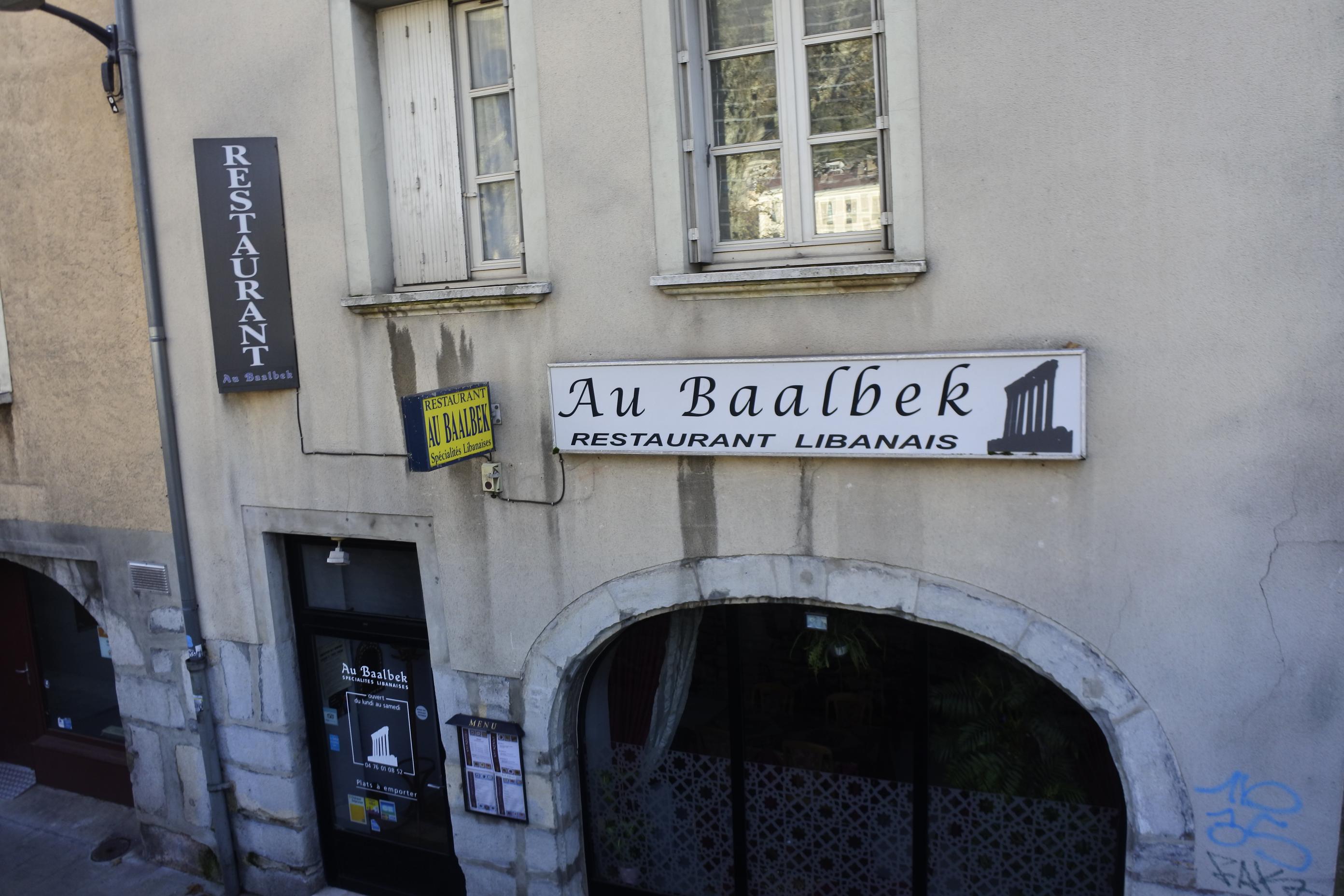
I did not take breakfast at the hotel the next morning and went on a walk to find it instead. Eventually I ended up at a cafe where I had breakfast: scrambled eggs, two strips of bacon, an espresso, orange juice, a salad with two grape tomatoes, slices of sourdough accompanied with hazelnut spread, raspberry confit, and butter. I finished everything but the bread and the accompaniments. The eggs were awful, a few crunches of shell, I stayed there and continued to read for a while before looking on my phone's map via the cafe wifi and realized I was close to the Musée de Grenoble. So I decided to walk there. En route, I encountered a restaurant. Au Baalbek Restaurant Libanais. The sign had a drawing of the ruins of Palmyra. I didn't enter but I took a few photographs and a video of a man outside it, doing some sort of work.
Many months ago I reposted images of the Palmyra Hotel in Baalbek from TripAdvisor onto Tumblr. And then maybe about a month ago, a mutual liked this post, they would have scrolled back through months of posts, after so much of my prosthesis, to find it, and I saw this through my phone, I looked back at the images and I clicked on one and I printed it onto a piece of printer paper. The printer had been sitting unused in my closet but had entered my life again in the last few months as I started to produce a significant volume of works on paper. I usually do not print from my phone but from my computer, where I have much more control over the image before I print it, usually onto a Japanese paper where inkjet and watercolors have a different material reaction than normal paper. This was about the novelty of printing from my phone, I hadn't yet decided to make a work so I printed the image onto a regular piece of printer paper, although soon enough after I would trace it onto a very thin piece of kinwashi and then painted in parts of it. But this scan is signficantly different than the work on paper itself, the backing of the scanner fills white into the translucent parts of the paper, creating a much more stable ground than what exists in reality. I was explaining all of this at the bar, trying to, later I would explain it again, or try to, to L, in my living room, the difficulty of recognizing when the work became The Work, even when it was yours.
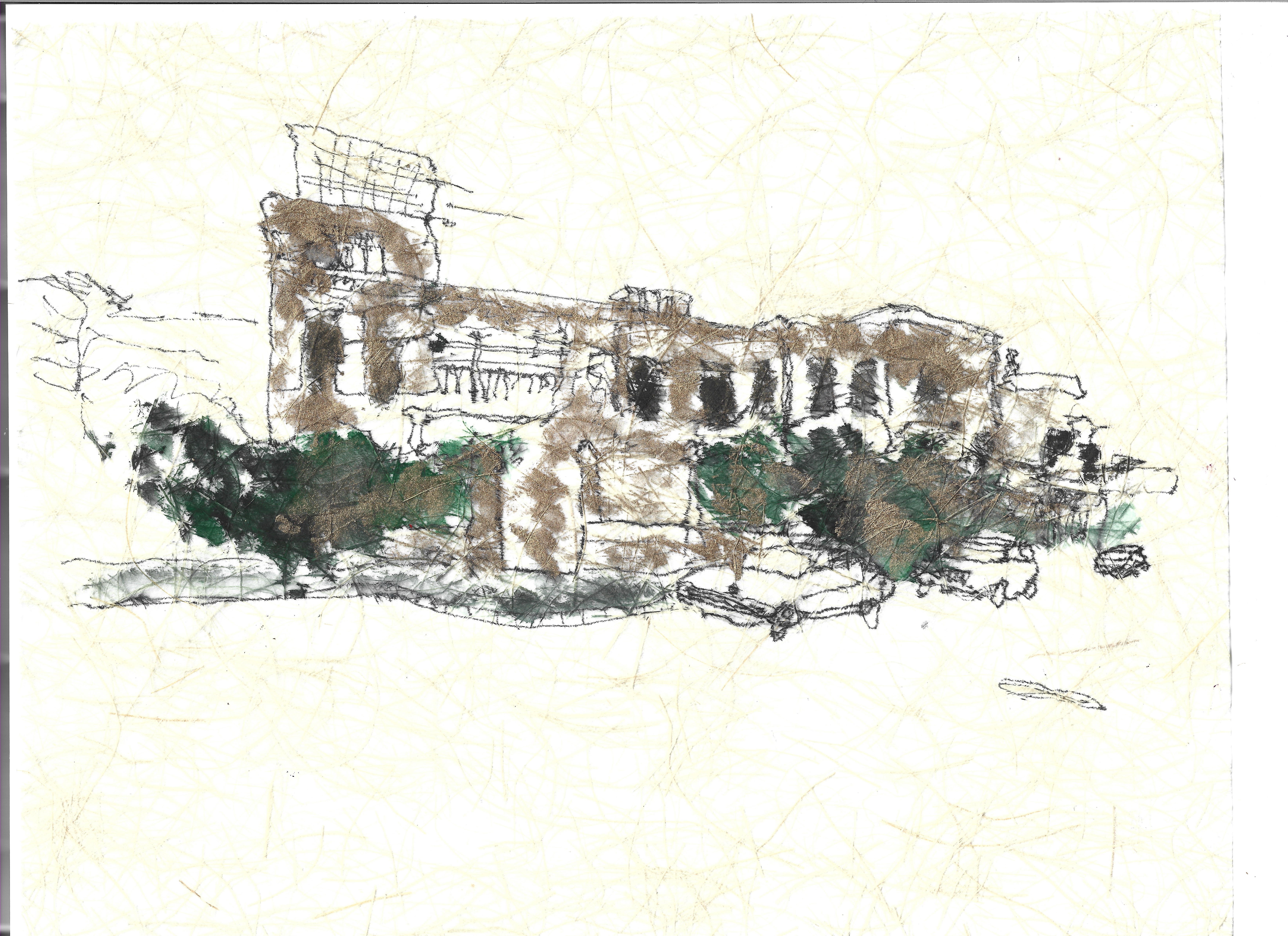
I was reciting a speech that I had grown comfortable with and had iterated many times over. Comparing the Tiepolo sketches at the Courtald to the frescoes in Madrid (I had yet to make it to the Würzburg Residence), explaining that I was much more moved by the smaller studies than the massive, monumental works, and attempting to find a suitable answer for this preference. Schlegel, the fragment, Romanticism, and so on. The leak vs. the official release. It wasn't logical, but emotional, simply just a matter of resonance in relation to the gaze, nothing to do with the histories of patterns of writings or paintings or image-making. This factored into the paper works because they were and weren't simply works on paper, but part of a larger process, of creating a digital image via the scan to then be manipulated and then printed once again, ideally at a larger scale, onto a material where it would be difficult to render such effects otherwise, like stone, or wood, or marble. Something like metadata, only there was a physical artifact. After some time, there was a last call and the taps for beer stopped working. I looked up from the Marías and walked up to the bar. I had another genepy and then walked back to the Hotel Gloria, the momentary intrusion of Baalbek had ceased.
Later, much later, I would realize that I had made an error. Or rather than realizing this error, I was issued a correction, by H, that the Marías recommendation was by way of her and not her brother. It was New Year's Eve, though it had passed, it was the early morning of New Year's Day, when she arrived with F and E and L to the party I was at, we were in the kitchen talking, and I started talking about how this recommendation had changed my life, altered my trajectory, of my thinking, of my writing, of my production, of my person, I started talking of the other things to come and the ideas that came of. Of Bad Translations, the idea of bootlegging Antonio Muñoz Molina's Winter in Lisbon, in order to finance the purchase of the lone out-of-print English translation for sale online, and in turn be able to read a Good Translation. I started to walk through my process of Bad Translation, a method which I had completed and discovered for the first time in the summer while translating an interview between Jacques Rivette and Pierre Boulez. The interview was from an issue Cahiers du Cinema and was referenced in an academic text about Rivette that I cannot precisely recall but was reading earlier that year. I was able to source a pdf of the issue via KG, which I have access to because of I, but automated machine translation services such as DeepL were not able to properly parse the scan and extract characters to provide a machine translation that would at least provide me with some semblance of meaning.
As such, I proceeded by transcribing the entire interview into a word document, the program open on the left half of my screen, the pdf open on the right. While typing out the words that were not mine, I found myself believing that I was writing in French, that I had a higher level of understanding of the sequence of characters, building into the sequence of words, building into the sequence of sentences, building into the sequence of paragraphs — that I was constructing meaning from this act of transcription. Years before, I borrowed a book from C and K's apartment, Helene Cixous's The Exile of James Joyce. As I was borrowing the book, I did not have liberty to underline and annotate, instead I sat with a notebook and the text and what seemed exceptionally necessary to extract from the text I extracted, into my own notebook, painstakingly, by hand. It was slow, but I had time, and by the end my handwriting had improved significantly.
I continued this process that year and in the years that followed, though I switched over to typing, in part because I was traveling and found myself mostly reading PDF's on my computer, and writing onto webpages like this one. Transcribing in this matter felt akin to creating a study or a copy of a painting, tasks undertaken in order to better understand how the thing was made, tasks undertaken to refine one's craft. By copying in this manner, whether this was Hedayat[1: add footnote/clickable number that creates small pop-up with specific quotes from PS/Re:or/etc.], or Blanchot[2], Carrere[3], or Vila-Matas[4], I believed myself to be writing the same characters, words, sentences, paragraphs — that I was constucting meanings, although these meanings were not Hedayat's, nor Blanchot's, Carrere's, nor Vila-Matas's, Cixous's, nor Marías's, Snijders's, nor Robbe-Grillet's, and I only became ever more aware that I was not writing the words of these writers, but the words of their respective translators, that I really read so little that was originally written in the English language. Or maybe not so little at large, but so little literature; the flows of text from my screens remain dominated by English, whether that is Instagram, Youtube, news sites, or downloaded PDF's, generally academic essays, news articles, long-form journalism — in some words research.
But literature I prefer to keep away from the screen, in its "original" book form (despite who knows how many corrections, re-prints, translations, and such each book has iteratively passed through, with forewards and afterword added, then redacted, often in response to the time, the conditions of the text's reception), where the technical qualities of the book — its size, its weight, the quality of the paper, and most importantly the turn of the page — provide a sort of anchor for the experience of the novel. In the twilight of my teenage years I read Ulysses and the first three volumes of In Search of Lost Time. I cannot recall what edition of Ulysses I read, but I slogged through the first third of the book for many months, specifically struggling with the Proteus chapter, my inability to relate the knowledge within myself towards the text to construct meaning in a proper way. This would continue, with ebbs and flows, until I spent three days at a family friend's house close to the coast of Tamil Nadu, somewhere close to the midpoint between Madras (now known as Chennai) and Pondicherry (now known as Puducherry). I did not have internet for those three days, or rather I declined to connect to their network, and instead found myself fully engrossed in the flows of the book, to the point at which the gaps of my knowledge, suffered from an absent education, did not matter as I constructed meaning from the text, the text alone, the text in relation to the text. Now, as I type this, I realize the similarity of reading Joyce without an education, and transcribing French from a state of near-illiteracy.
Proust on the other hand, I read on a Kindle, which I took with me from India to Paris to Lyon to Barcelona to Oviedo to Porto to Lisbon to Frankfurt to Noordwijk to Amsterdam to Dublin to Galway, where I would leave it at a hostel, midway though The Guermantes Way. I was never able to recover the device, as once the hostel had found it I was no longer in Ireland and there were shipping restrictions on the type of battery it used. Its memory was wiped and it was given to a member of the staff. Is what they told me. I was not upset. The work felt corrupted, sentences spanning multiple swipes of the screen, an inability to feel the weight of a sentence, a paragraph, wandering its way across turns of the page, the experience of time itself in relation to the text altered. Matters of technics, of objects and their qualities, like the ability to Command+Z and see a brief erased history, or the ability to upload a text and have it translated from language to another, or the ability to speak into a box like the one Y had in Lausanne, which translates the speech and regurgitates audio of the translation, I was explaining parts of this in relation to Bad Translation in the kitchen at the party, how the next part of my process was to use DeepL to generate a machine translation before then moving into side-by-side windows once again, viewing the translation in relation to the transcription, and proceeding sentence-by sentence to rewrite the English in order to best represent the ideas of the original.
While watching a video of Marías speaking on Youtube (I cannot remember if it was the Louisiana Channel or the 92nd Street Y video), I scrolled down to find a comment surprised by his sub-par command of the English language (the commentor's opinion, not mine), given his past experience as a literay translator, and that the narrators of his books are interpreters and translators. Someone had already responded the a good translator need not be an expert in the language that they are translating from, only an expert in the language that they are translating into. I thought of and explained out loud that this automated machine translation was a means of saving time, in the past amateurs in my sitution would have to consult a dictionary, constantly looking up unfamiliar words in a painstakingly slow process, like transcribing passages into a notebook by hand. S told me as much when I asked him about the Daney translation he published. He said he was doing a residency in France and that that emerged from it, that it took too long, that there's a reason why he hasn't done it again. In another video (or perhaps the same video), Marías reads the English translation of one of his books, possibly for the first time, beginning a conversation about unfamiliarity with a work that is ostensibly his.
I felt confident in my ability to translate the Rivette interview largely because of the time I have spent with Rivette in the last few years. I have described many times over how I lived in Chicago, staying at P's apartment just a few minutes walk from OBlock, without a car, nor a real job, attempting to reorganize my life with an empty bank account and no place of my own stay following a hospitalization in India due to dengue fever and a recommendation to leave the country and return to the U.S., so as not to risk reinfection. Soon after I would arrive P would leave, to the UK, to conduct research for his Ph.D. He too transcribed, though I imagine his to be much more difficult, leafing through 17th century documents in libraries, attempting to decipher scrawling cursive [something something illustratve]. With no work, no reliable means of safe transportation, and most importantly nowhere to go, I spent close to two months living in a near-noctural manner, waking up just before sunset and going to sleep as the day broke, living in a darkness that was like a cinema. P's living room had a couch and a television. It was as though my reality had ceased to exist and that all I could do was enter others.
Naturally, there was a requirement of chance to bring me to Rivette. I was on A's website, where there is an image, and if you click the image it is replaced by another image, and one can keep clicking and clicking and advancing through this succession of images. At a certain point I arrived a still from Celine and Julie Go Boating, which operated almost, almost, as a Proustian madeline, though the mechanism of recollection took much longer. There was something about the Celine and Julie still, a film which I was well aware of as a signifier but had not seen, it awakened a memory, a feeling, and I found myself recalling a scene of a woman following another woman, the sequence playing over and over in my head like a song stuck in one's head, where you can hum the melody but the lyrics escape you, and you have no way of figuring out what the song is on your own. Only there was no one to sing to, no one to describe the song to, like I had done earlier that year in a car with A and Z to recall Natalia Imbruglia's Torn, and the ghost of the scene continued to haunt me for a series of days before I remembered. The scene from Duelle, which I had watched on Tubi a few weeks prior, in a hazy state [permeated] by post-illness fatigue and edibles. At this point I downloaded most of the Rivette corpus and proceeded to watch them chronologically, stalling out after La Belle Noiseuse in a sort of effort to conserve the remaining Rivettes for first-watches to space out for the remainder of my life.
As such, many of these films I would watch many times over. I felt a deep bond with him, with his relation to the secret, to a conspiracy that gives one purpose and a reason to live, a fundamental sort of mystery, illumination, and enchanment that exists within, besides, in relation to this state, this way of being. In the following years, I would slowly pace out further first-watch, not at regular intervals, but in moments where I felt as though I needed an external source of vitality, a sort of pharmakon-cinema of the secret. The secret, the secret. After watching Secret Defense I would write the following:
The thing about Secret Defense is that you actually find out “the secret” unlike the other Rivettes which move about the secret, where the secret is fundamentally unknowable. The secret in Secret Defense is not unknowable but unspeakable — no one is able to utter the secret in its entirety. Which is the cause of Sylvie’s death. The impossibility of speaking the secret is the cause of the film’s final death.
The impossibility of speaking the secret is the cause of the film’s first (on-screen) death. The final death that preceded the commencement of filming, the last death before the initial cut, is not the secret. The death is known. As is the first death before the initial cut. After the death[s], the authorities assemble the evidence in order to create a reconstruction of the events. The reconstruction leads to a judgement, a cause of death is assigned. This cause is not the secret, nor part of the secret, but the veracity of the cause is. Only truth is not a binary, but a spectrum, or rather a topological space, where true and false do not represent fixed points but rather regions whose boundaries remain indeterminate — truth values exist in relation to one another within this space but cannot be assigned definite positions or topoi; true and false mark distinctions that dance about points rather than being definable locations. J.D: There is in every poetic text, just as in every utterance, in every manifestation outside of literature, an inaccessible secret to which no proof will ever be adequate… ‘One will never be able to prove that someone has lied.’
veracity (n.) 1620s, of persons, “habitual truthfulness;” from French véracité (17c.), from Medieval Latin veracitatem (nominative veracitas) “truthfulness,” from Latin verax (genitive veracis) “truthful,” from verus “true” (from PIE root *were-o- “true, trustworthy”). By 1660s as “fact or character of being true.”
Curiously, the first death strikes Véronique, who goes by Vero, whose name comes not from verus or were-o but from the Greek, from Berenike, goddess of Victory, rendered into Latin as Berenice. And Vero, this embodiment of a misheard truth, is replaced by a double. It is the double that pulls the trigger. Sylvie dies at the hands of near-truth’s double, hands which have pulled the trigger of Paul’s gun.
One can retrace the sequence of fallen dominoes the lead to this final death, a final death that is a reversal of the first death. The movement swings back and forth, like an idealized Newton’s cradle. Science functions as a fundamental staging device, with action migrating between the laboratory and properties purchased through the wealth of Pax Industries, the weapons company Sylvie’s father ran with Walser. A final etymological concern: that Pax is latin for peace, that the first domino fell for peace. And with it, a cemetery was borne.
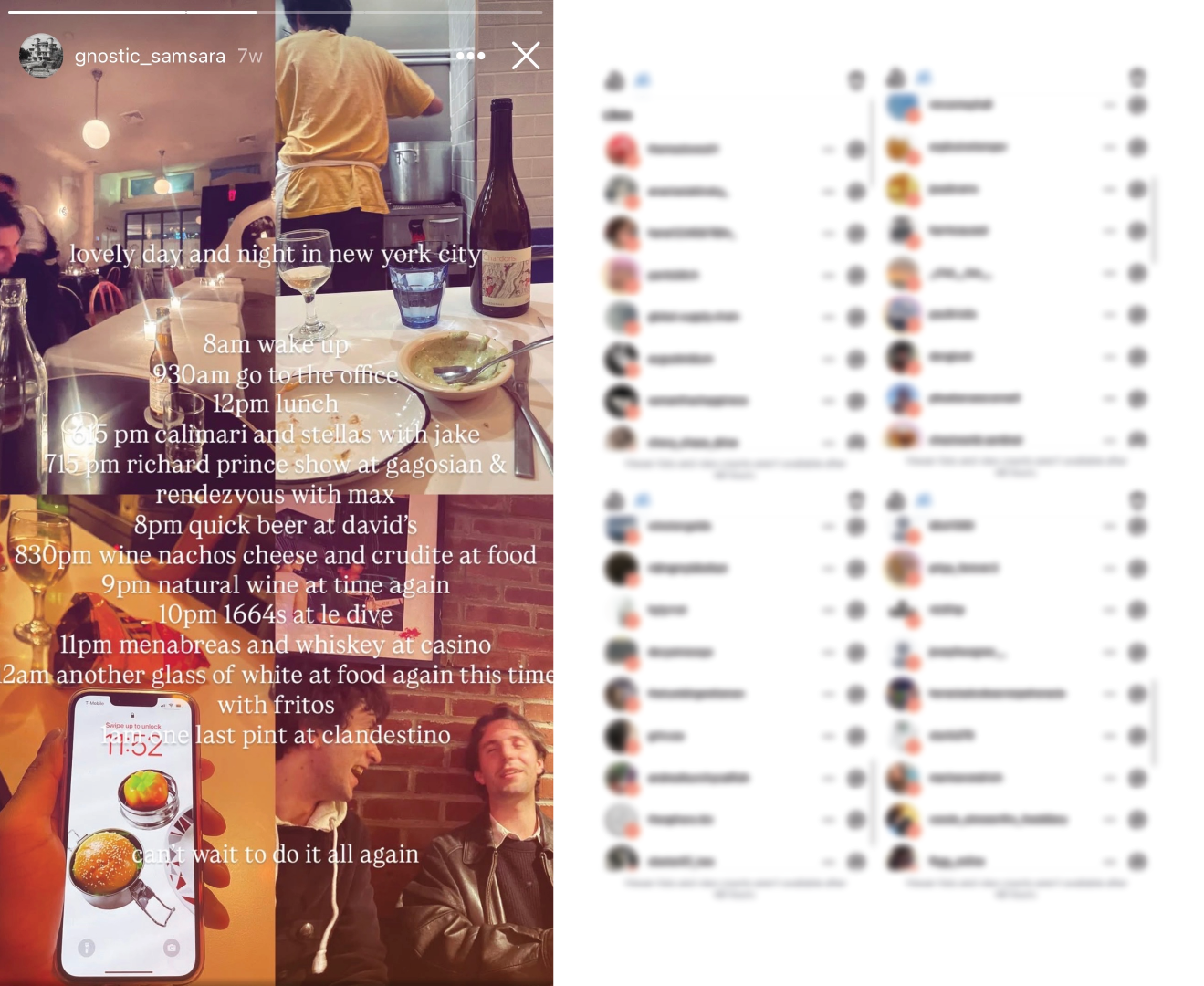
I then began to talk with H about her writing, which I have not read, and a text that she was going to write, the excitement of getting to read something from someone you know and respect highly as a reader. My error of attribution lingers, it serves as a link to H's text to come, its relation to a conversation with L on the phone the previous day, in which I propogated said misattribution for the first and last time. Excusable? To some extent, that is a word that works, as the night that H gave me that recommendation was one whose existence in memory has signifantly eroded. J had just gotten back from Paris, and I had not seen him in a few weeks. We met after work, at a bar in Chelsea, an Italian bar, without Peronis, but had a very affordable draft happy hour Stella Artois. We each drank two and split fried calimari, another happy hour special. Perhaps this erosion is not completely true, I remember, I believe myself to remember this part of the night fairly well. We then met M at Gagosian for the Richard Prince opening where we ran into H, who came with us downtown afterwards. First we went to FOOD, where P works, but there was a wait so we went to David's, a bar nearby for a beer before walking back to FOOD with the beers before they were finished, as almost immediately after we left P messaged me on Instagram to come back, that there was seating, and once we were seating, knowing that I'd get some sort of discount from P, I ordered a bottle of wine, and while drinking this wine either M or J had an idea (H left to go home as we were getting seated), the next day I believed it to be J, but he denied it, ergo it must have been M, but the idea was the "Canal Street Challenge", to attempt to go to every bar on 'this side' of Canal Street, and I do remember saying that we have to do it tonight, otherwise, at any other time, it will seem like too awful of an idea, so after nachos and cheese plate and crudite and check, we went to Time Again and drank orange wine, there were many people outside as always, some sort of afterparty for an Office Magazine event, a photographer asked if we had gone and we said yes, so she took our picture and we talked to her, she had just came from Italy, we asked why she was there and she replied "Generational Wealth", I had forgotten that last part but M remembered and recalled it to me later, then it was Le Dive for the first time for all of us, three 1664's, M bought the round this time, then Casino, Italian beers, the bartender insisted on giving us a free shot of whiskey before we left, which is really where the memory erodes, he insisted because when we walked in we asked if M or L were working, hoping we could get more free drinks or discount, but they weren't, but I think the bartender, whose name now evades me, due in part to this erosion, liked our spirit and thought of us as friends of friends by the time it was time to leave, we went to FOOD again, I would later joke about inventing FOOD Again, a new restaurant, and we would drink wine that P gave us and at this point it's all a blur in relation to my prosthetics, photograph of cell phone (later identified as P's), stickers on my sweater, crushed Fritos bag in my pocket, Clandestino's, Guinness, throw up in bathroom, Uber, open door, vomit again, arrive home, collapse into bed, the most vicious of hangovers at work the next morning, we were all late. J would post a picture on Instagram, I would repost it to my story and create a story of my own. It was one of my most liked stories of the year: