November 11, 1933
I was given a shovel and a task. This did not make me unique. These were the circumstances given to many. I was on a ship, I was tasked with its maintenance, along with many other men. This did not make us unique. These were the circumstances, given to many. I was given a graphical utensil and a task. This did not make me unique. These were the circumstances, given to many.
I am bad at chess. A relative statement. I play every day. A fact. It has been over 200 days since I have gone a day without playing chess. In all of those days, I have not improved.
Sometimes it does feel all written already somewhere... Time passes and I’m not as old as I would like.
There are moments in history in which everything is fused, plastic, malleable; and in these momsents only a little push is needed in order to change the course of events. This push can come from an individual, but the individual who is capable of giving the push will himself be the best product of his time; he will hardly be differentiated from it as much as a fleck of foam on a huge wave.
I wanted to begin with the egg, with the idea of hatching. Those questions from childhood, full of wonder and glee. Time passes and I'm not as old as I would like. Still, I like that I play.
I was drinking, I was drinking with people, I was talking, I was talking with people, all of these I's were there, but today I am different. I am interested in particular, and almost certainly narcissistically, in the performance of naming and the role it plays in an aesthetic agency that revolves paradoxically around singularity and iterability:
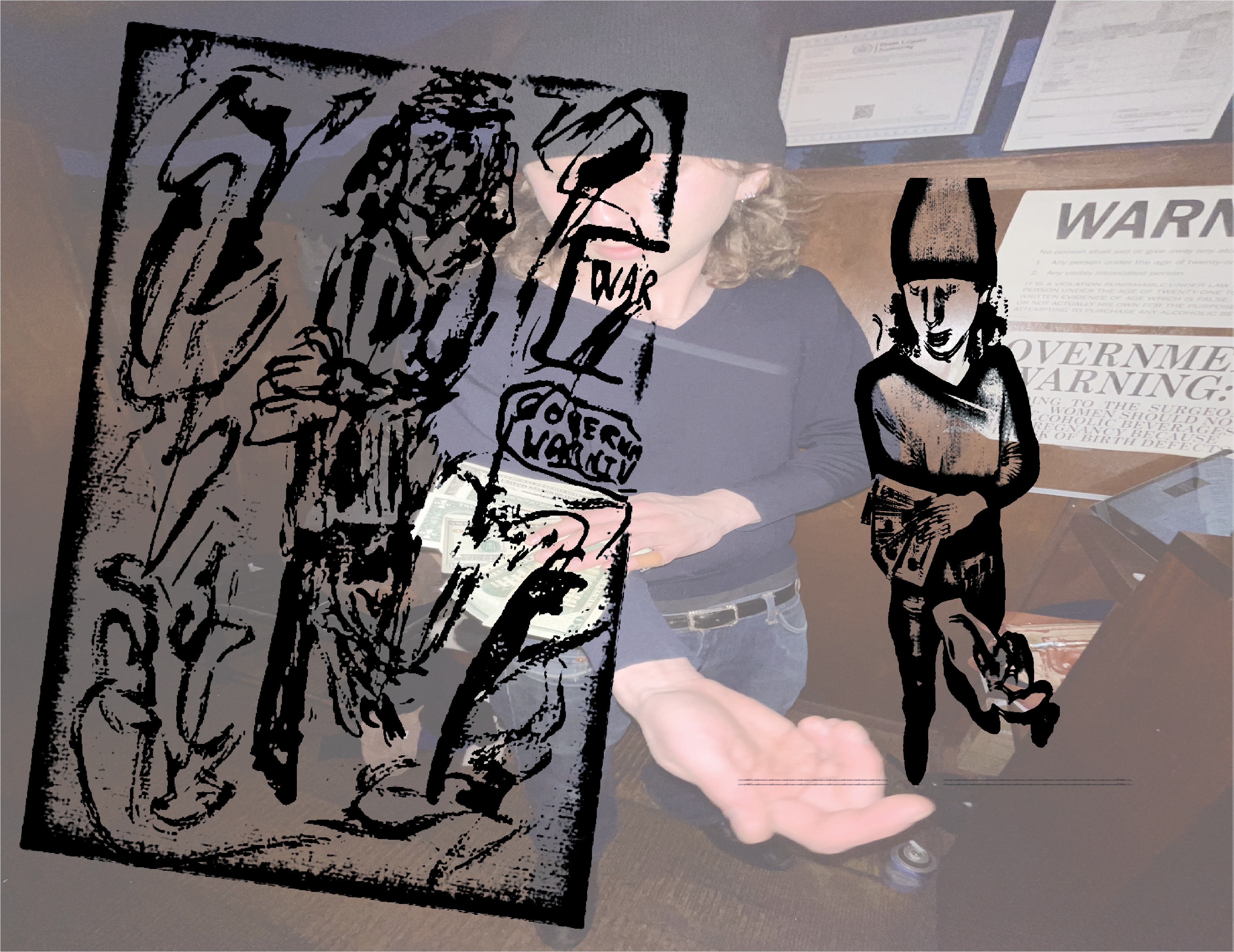
He meditated on the money spread, counting the dollars down his arm: 20, 20, 20, 10, 5, 1, 1, 1, 1, 1, 1, 1, 1, 1, 1, 1. The money could be longer, the world was getting shorter, there were sequences of remembering and forgetting, there was a lost and found. (In the time to come: I used to put that shit on / I still do / money got shorter / problems got longer / still / turned to a savage. Fuck if that ain't the truth.)
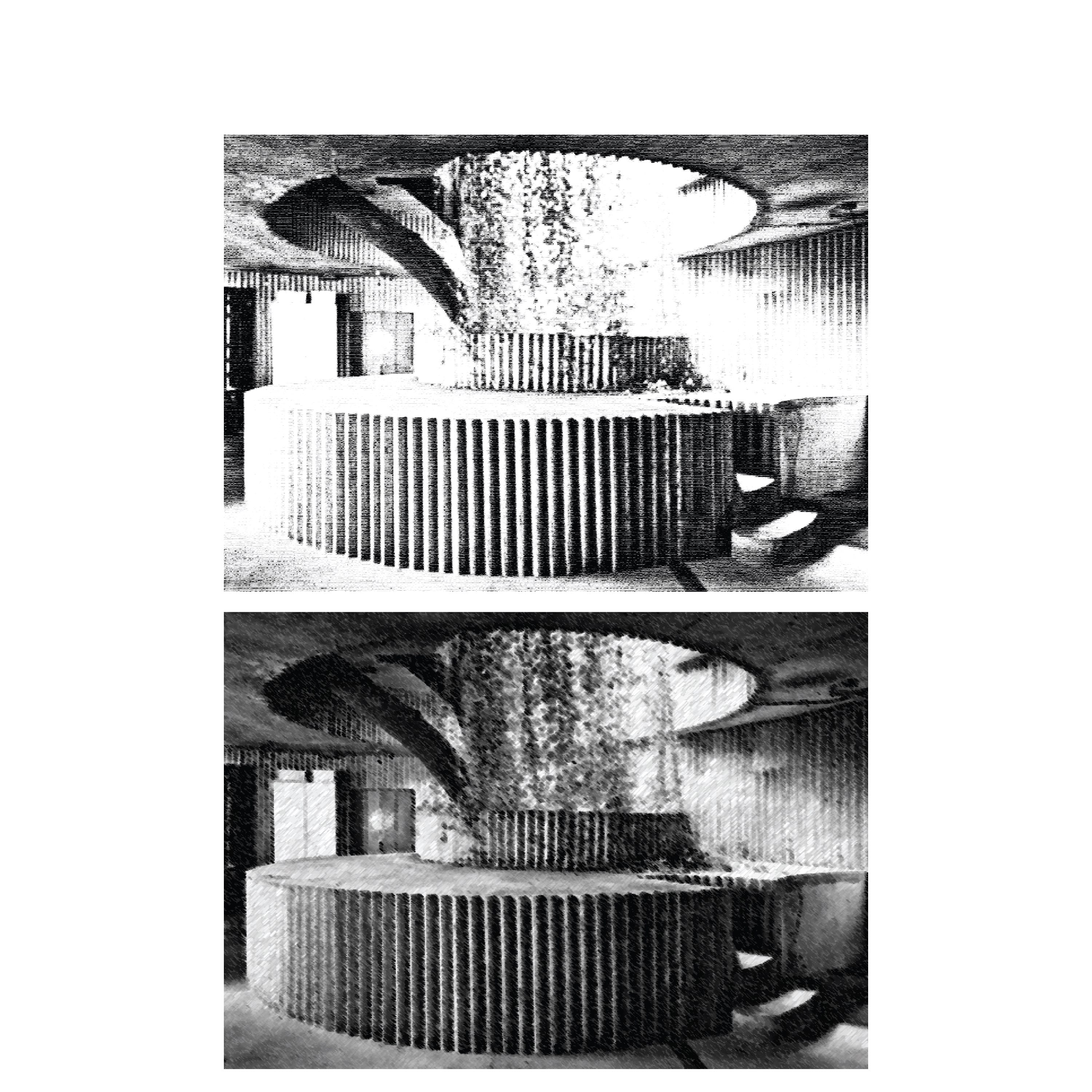
There was a lost foundry, where metals were once melted and poured like drinks, a gathering-place of scrap from around the world, relocated to this secret where iron mixed with zinc mixed with aluminum mixed with substances thought to be drawn from the Earth's core, minerals that have since been forgotten, that created metals mixed together to create alloys strong and malleable, the beams that built the world as we knew it, that maintained our infrastructure, that allowed us to build that semblance of home among the towering glass trees that swayed and bent ever so slightly in the gusts, the creak of the building singing a song of safety, a melody conveying that this assemblage would not snap with the whims of nature, that the magnetic nature of every shaft in the skeleton was designed to specifically match the industrial goods inside, where these same alloys danced in relation to one another, forming a series of invisible circuits that would hold everything steady, even when the tree would become willow wisp in the wind, carrying a near sideways appearance to those on the ground, only the grounddwellers could not enter this lost world, nobody could, they could only stare at it in horror and disgust, it was impossible to find the entrance, it was impossible to find the foundry, and this mass of people that made up 'nobody' was so many, it was the mass, that volume of the world that is incomprehensible, like the idea of a billion people, like the idea of a million people, like the idea of the many millions living in abjection because of complex systems designating that that must be their state of affairs, so they wait for the building to snap, as the building bends and bends and bends, while the Rococo paintings inside remain fixed to the wall, the marble columns and sculptures from ancient worlds migrated within the tree stay put, anchored into the spine of the structure, and the steel sculpture wrought within passages of the building stand tall, weathering deserts within, in the rooms of the tree with sand that was borne with the hourglass, with winds that would whip this internal lacuna into a chaos, a controlled chaos, one that had boundaries, there were limits to how much the state of affairs could fray, and the tree seemed to be growing, it was stretching towards the sun, like any plant would, it needed energy and it stretched and stretched and stretched while its roots dug deeper towards the core — it wanted the world, this tree that would one day become the world's greatest fossil, swallowing itself whole: and out of the snake, emerges a Man.
Once again, there is so much World.
 Why is an echo - as we have already established, an act of love, of listening and of restoring- so threatening? Why does that sound, which is in fact our own sound, recast by means of another, undermine and even threaten to annihilate our sense of who we are?
Full of lack, he wished someone would catch him lackin. They laughed at it at first, but time did move differently depending on what room of the city one found themselves in. He used to say that a lot, that New York City was a city full of rooms, and maybe that was one of the first times in which he started to view the world as a puzzle, or a system to be manipulated, that certain actions would get one access to certain rooms, that there were certain people in certain rooms, that certain rooms weren't even rooms. Now it felt natural, he moved through rooms and there were many rooms to move through. Naturally a picture began to form, or rather an idea, but he wondered if it was possible to visualize and he remembered a since-discarded fragment about what paintings could be. He attempted to render it before realizing that the lines were drawn wrong — he wondered if such a possibility could happen to him. He had never considered the possibility that his haphazardly constructed map, gleaned together not from a rigorous science but rather one of instinct and habit, could be filled with errors. But this was more than an error, this was an attempt which was approached with the wrong methodology, and what was rendered... it wasn't faithful because there was no mental image to be faithful too, and when he realized this it began to open up again, this idea of what this picture could be. And then there was a bloom:
After the petals had fallen and the seasons passed, after
the most beautiful summer he had ever lived through, and after wrestling with that idea
of beauty and what he had meant by that, after the after and after
the afterafter, after all the afters, he realized once again, he had realized before and
remembered what it was like to Realize, the lack of lack was a plague and he was only living
on a certain plane, one which pulled at him in so many directions, a plane containing a certain gravity
that he abstained from investigating in a formal, rigorous manner, rather choosing to allow this magnetism
to guide his body as he learned intuitively, from trial and error, while leaving himself open to chance and to change.
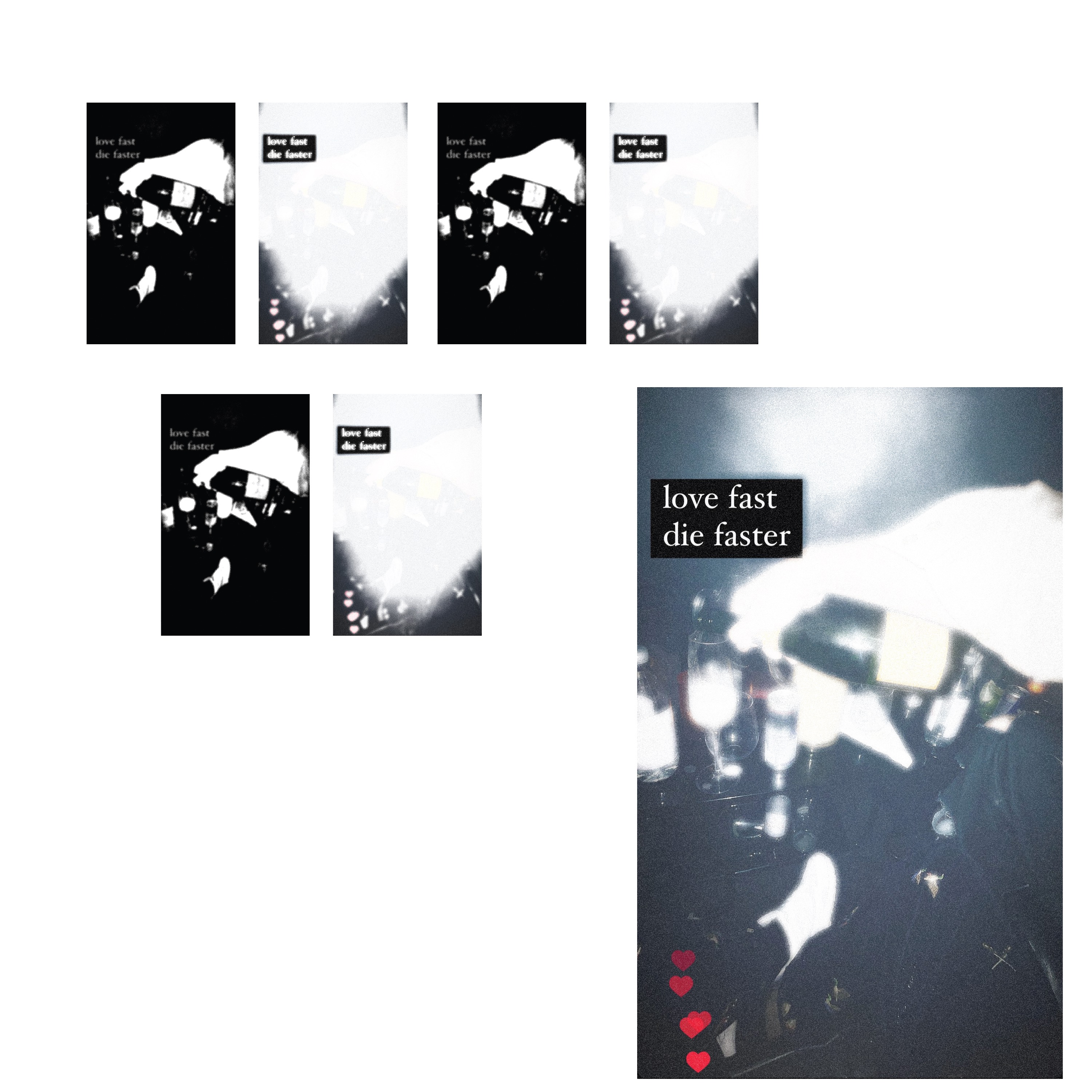 He repeated that familiar line, yet it remained unsaid and he felt broken, like a sapling with a split trunk, yet he felt ancient, as though the soil in his palms was something he'd been reaching down through his entire life. And he repeated that phrase — my entire life — only feeling closer to death: it seemed that that was the only direction one can have in life, that of being-towards-death. There was an error that he allowed, he liked it better that way: love fast, die faster.
It felt nice to repeat, to continue repeating the error: love fast die faster
He attempted to catalog, as much as he could,
it was too much:
Living this fast life tell me where the love @ scratch that tell me where the plug at 💯
The machine is different now
What was written before cannot be written now
"It is only later that the traveler appreciates the human suffering that has made all this possible"
– Friedrich Engels (1844)
February 11, 1931
I sought out to write a story. I built it from fragments of the past. There are some fragments of my past that are lost. In fact, there are many. In time some might be found. On the beach we were talking about forgetting and remembering. I went in the water, into the ocean for the first time in just over ten years. The ideal biography for most readers is that in which the loves and the broken love affairs of the people in question are recounted; their habits, and the pattern of their home life, what time they go to bed, that at 2 a.m. they pay a visit to their wife (or to their mistress), that then they take a purge, go to the bathroom, and return to work well rested the next morning.
My favorite lie is the one Laszlo told me at the afterparty for a show, let's say that I cannot remember whose show, and that he told me Infinite Jest was on Oprah Winfrey's Book Club and women used to cut the book into pieces with a knife in order to read it more portably in public. If a lie is good enough it becomes real, in the sense that the existence of the lie becomes a fact. That it's my favorite lie is perhaps another lie. The question of veracity, then we can go back to the Enlightenment, you trace things back, develop conceptual etymologies, and so on. In other words his writing, the one through which he publicly declares his wish "to speak to the public today about a singular man," is a betrayal from one end to the other; it is the betrayal of a friend and a secret, but it is also a betrayal avowed, confessed, by means of which the author appears before us as before the law.
This text is a confession and, as always, the confession of a secret, a secret fault; but here it is a confession that consists in committing the fault for which one confesses. It betrays the secret by saying that it should not do or should not have done so. When one doesn't want to betray a secret, it's better to keep one's mouth shut and not to say "there is a secret," or "I shouldn't tell you this, let's keep it secret, etc.": a familiar scene.
He was screaming at the river, not at the water itself but at another man — something to do with the improper use of fire, a sort of Promethean quandary. The rules were firmly delineated after he yelled "I work here," and it was far from nature, with CDJ waves and a dizzying circulation of crystallized powders, crystallized vessels, crystallized beings. I thought I was explaining what was happening to others who had only heard the noise but it was an event beyond explanation. The next day, Prometheus was unbothered, we texted that this time wasn't like the past and that this place wasn't the Basque Coast. The secret is perhaps not inevitably, necessarily, essentially the private, or the interior, or the domestic, or the subjective. Is it still possible? This is what I've been wrestling with, the inevitability of this I and how it appears. I try to enter in a certain way, and I cannot make it so. It necessitates change. This I must change. I'm reminded of this constantly now. I go out, I go through the motions, and then I question those actions. The crowd is the place where the most public and the most secret condition each other, pass instantaneously from one into the other, and it is in virtue of this. The question remains to decide what replaces the crowd in the metropolises of the West. I insist here on Western metropolises: there are no more crowds in Paris, London, or New York; there still are, perhaps, in Jakarta or Dakar. Nothing is secret anymore in a newspaper, but nothing is more saturated with secrets than a newspaper; the newspaper is made for telling secrets, and that is its condition, the condition for its sale and diffusion: secrets must be told, and the profession of the journalist, like that of the detective, is the hunt for secrets. Going through the motions is not having motion.
Naturally, language is changing. I repeat what I wrote elsewhere. But here it's different. The voice is different. The presentation is different. The reading is different. A signature is not a scribble, nor is it a name — it is something else, a tendency, a habit, a way of making marks that has little to do with the name, but is often relegated to that domain. I realized that this has nothing to do with abbreviations or initials, but rather with the polyphony within, finding a way for the voices to dance with one another. Referents enter: Hopoutblick and Ybc Dul's "Too Many Names", then "McButtons & McNuggets": The Ooga Booga Joint. There is no Pessoa trunk here, no scraps of papers to piece together into a manuscript. I don't think it's possible. And there was a lot of talk about nothing, dancing on surfaces, ice skating. I wish that one could look at a conversation from above, the way you can look at a rink after a dance, a routine, a sequence. Not my territory but it's beautiful. I asked a girl recently if she liked sports and she said ice skating, but I can't remember who this was. I thought about crushes this morning, and how long it's been since I've had one, and my relationship to desire in general. He loves secrets, apparently, as he does anonymity, since he refuses to respond or answer for his name in what is called a signature. He wants to erase his own name. He felt ill, exhausted and his body felt heavy. He realize how many words were sitting around him, in front of him, unread. And that it would be impossible for him to have read all of them. But the signifiers, the references, those could be mapped. And he remembered the importance of prayer, the importance of health, the importance of the body, considering all these categories in relation to maps.
He wanted, curious author that he is, to seduce his reader and whet his curiosity, his unhealthy taste for the secret. A curiosity that in this case leads to unmasking an incognito and getting to know someone whose genius is none other than the genius of curiosity. It is priceless because it isn't even money. If that's how things actually stand, then the most secret is no longer secret at all. And in describing his drawings, he no longer unveils a secret. He perhaps describes the secret of his works, as art, but this secret is not a secret name, a representable secret, a secret that one keeps in one's possession. It is different to write a single sentence here than it is to write a single sentence elsewhere. I remember silence as a form of speech. I think of writing the most perfect secret.
The only secret that remains is the one of the encounter, the randomness of the encounter in which two signatures cross each other, what Celan calls, in "The Meridian," Geheim-nis der Begegnung, the secret of the encounter, in which consists the poem. At this point one can no longer distinguish the secret from the non-secret, the private from the public, the natural or originary from the institutional, non-literature from literature, truth from fiction, the non-signature from the signature. I get to write what happens next.
Then he resolved to devote all his efforts, from tomorrow onwards, to finding out the cause of and the interests involved in this mysterious affair. It was a novel he might read: better still, a drama to unfold, one in which he would have a part to play. In the case that there was not a great conspiracy, he realized that he had to invent one. Luckily, there was a whole tangled web of lies truths and associations to get lost in. There was something that could be formed from floating speech. He began to map it out — the constitution of an Event. There was nothing to see, there were three men wandering about like blind mice. There were beers. Everyone was playing pretend. Pantomiming fake language interactions reflections condemnations. It was the question of mediocrity — no one asked it, but it voiced itself from the sewer and snaked around the ankles of everyone walking past, grabbing, tugging, pulling, flipping people over. The ground was stable but the environs were not. One must conceive of oneself as the most dangerous rendering to arise since the very prelude of one's medium: otherwise, why bother to knowingly produce inferior samples? It is that here, mania shows us a paradigm of intimacy along-side complete anti-modularity: that no pieces should be interchangeable within a tradition; in fact, when such flexibility of components occurs, the tradition should be destroyed and put out of its misery. Nothing is isomorphic, lending to styles that are inimitable even when taught (a densification process that allows neither forebears nor followers)...
... mania excels in the logic of originality-through-capture.